You’re One in a Melon: Graphics for Crafts & Sweet Branding
As a graphic designer who’s built brand identities for handmade businesses, seasonal campaigns, and print-on-demand sellers over the past 12 years, I approached You’re One in a Melon not as a novelty clipart download—but as a potential creative design asset for a real client project. Specifically, I was developing visual assets for a small-batch botanical confectionery brand launching its first Valentine’s Day collection: artisanal watermelon gummies, hand-poured candles with citrus-melon notes, and limited-edition gift boxes. The mood needed to be warm, playful, and tender—not saccharine or cliché. That’s where You’re One in a Melon stood out.
A First Impression That Feels Intentional, Not Stock
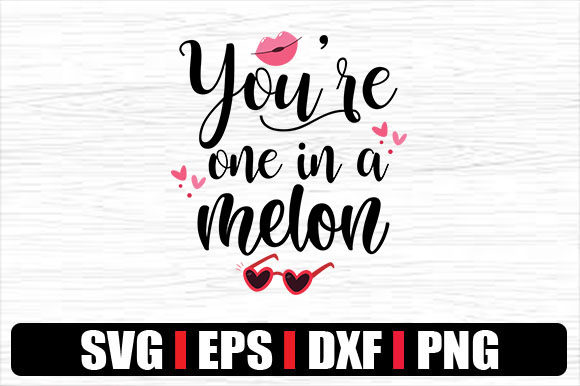
Opening the files, I immediately noticed the balance between whimsy and craft. This isn’t generic Valentine’s Day clipart—it’s a loving Valentine’s Day quote design with thoughtful spacing, soft curves, and subtle texture in the letterforms that suggest hand-drawn charm without sacrificing scalability. The vector SVG files retain crisp edges at any size, and the PNGs include clean, fully transparent backgrounds—no fringing or semi-opaque pixels. Visually, it leans into modern design with a handmade business sensibility: rounded sans-serif base letters softened by custom melon-seed accents and a gentle tilt that implies warmth, not wobble.
Where It Shines in Real Client Work
You’re One in a Melon performs exceptionally well in contexts where emotional resonance matters more than rigid formality. In packaging design, it anchors gift box labels and sticker seals—especially when paired with kraft paper, matte laminate, or soft-touch coatings. On product mockups for mugs and tote bags, it reads clearly at 3–4 inches wide, holding attention without overwhelming the item’s shape or material texture. As social media graphics for Instagram posts or Pinterest pins, it adds instant thematic cohesion to a campaign grid—think flat-lay photos of candies beside handwritten notes, all unified by that shared melon motif.
For editorial design and blog visuals, it works beautifully as a decorative accent: centered atop recipe cards, tucked into corner banners for email newsletters, or scaled down as a watermark on printable wall art for Etsy listings. As a sublimation design or Cricut project, the SVG paths are cleanly layered and grouped—no stray anchor points or embedded raster elements. I tested it in Canva templates too: dropped in as a branded header element, it elevated a basic “Valentine’s Special” announcement from functional to memorable.
Best Fit: Themed Collections, Hero Graphics & Emotional Anchors
- Hero graphics for landing pages or seasonal banners—its friendly tone sets an inviting first impression
- Product mockups for t-shirt design, mugs, and reusable bags where personality drives purchase decisions
- Themed collections (e.g., “Melon Love” gift sets) where consistency across touchpoints strengthens recognition
- Printable designs like greeting cards and invitations—especially when printed on textured cotton paper
- Supporting brand elements, such as secondary logomarks or pattern repeats in packaging design
Where Caution Is Required
This is not a universal solution—and that’s part of its strength. You’re One in a Melon should be used carefully in minimalist branding systems, corporate marketing visuals, or projects demanding strict typographic neutrality. At under 18pt in digital ads or app UI, readability dips slightly due to the custom ligatures and organic spacing. It also competes visually on busy backgrounds—avoid layering it over complex patterns or low-contrast photography without adding a subtle drop shadow or solid color block behind it.
It doesn’t pair well with ultra-thin serifs or rigid geometric sans-serifs; instead, it harmonizes with friendly display fonts, relaxed script fonts, and rounded sans options like Nunito or Quicksand. For logo design, treat it as a supporting element—not a primary mark—unless the client’s entire brand voice leans into lighthearted, seasonal storytelling.
Designer Notes You Can’t Skip Before Use
- Test contrast: preview on both light and dark backgrounds—especially if using for web design or digital ads
- Check transparency: open the PNGs in Photoshop or Figma to confirm full alpha channel integrity (no gray halos)
- Verify vector editability: ungroup the SVG and test font replacement or color adjustments—no hidden raster layers
- Print-test: run a physical proof on your intended substrate (e.g., ceramic mug vs. cotton tee) to assess ink bleed or edge sharpness
- Review licensing: confirm the commercial license permits use in client work, especially for print-on-demand or Etsy products
- Assess hierarchy: place it alongside body copy and CTAs—does it support or distract from the core message?
Why It Builds Visual Trust—Not Just Cuteness
In a market saturated with generic love quotes, You’re One in a Melon feels curated—not algorithmically generated. Its specificity invites connection: it’s not “you’re special,” it’s “you’re one in a melon”—a wink, a shared inside joke, a nod to joyful absurdity. That builds visual trust with audiences who value authenticity over polish. For small business branding, that nuance translates directly into higher engagement, stronger recall, and more meaningful customer relationships.
Used thoughtfully, this graphic design asset does more than decorate—it deepens narrative. Whether anchoring a boutique product launch or elevating a handmade business’s seasonal campaign, You’re One in a Melon delivers emotional clarity without sacrificing professional execution. It’s a rare find in the creative marketplace: a design bundle that balances craft, commerce, and genuine warmth.