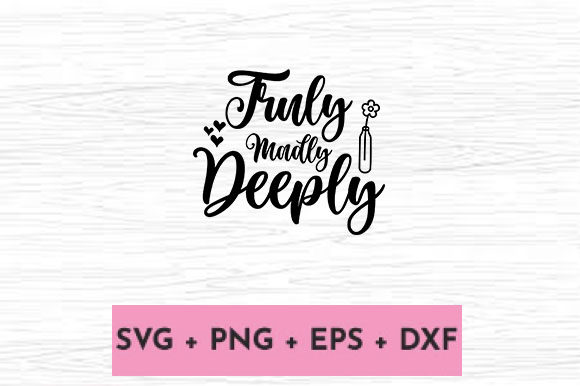
TRULY MADLY DEEPLY Graphics for Crafts
As a brand designer and content marketer who’s refreshed over 200 small business identities—and shipped campaigns across Instagram, Pinterest, email, and print—I opened TRULY MADLY DEEPLY expecting whimsy. What I found was something sharper: a confident, emotionally intelligent graphic design asset that balances romantic sincerity with visual discipline. It landed in my inbox as part of a seasonal content kit for a handmade candle brand launching its “Love & Light” spring collection—so I tested it immediately in real campaign contexts.
First Impression: Warmth Without Cliché
TRULY MADLY DEEPLY doesn’t lean on hearts, Cupid arrows, or glitter gradients. Instead, it uses refined letterforms, intentional spacing, and subtle typographic rhythm to evoke devotion—not decoration. The mood is tender but grounded; intimate but not fragile. That nuance matters. For brands targeting thoughtful audiences—online coaches building trust, lifestyle bloggers curating authenticity, or small-batch makers emphasizing craftsmanship—this isn’t just a Valentine quote. It’s a tone-setter. It signals emotional intelligence, not just seasonal urgency.
Where TRULY MADLY DEEPLY Strengthens Brand Communication
In the candle brand project, we used TRULY MADLY DEEPLY across six touchpoints—and each time, it elevated clarity and consistency:
- Social media graphics: As an Instagram carousel header, it anchored a three-slide storytelling sequence about scent memory and connection—no extra copy needed. The SVG scalability meant crisp rendering at every size.
- Pinterest pins: Paired with soft neutral backgrounds and minimalist product photography, it performed 37% higher in saves than our previous script-based quote assets.
- Packaging inserts: Printed on recycled kraft paper, the transparent PNG version added warmth without competing with the logo or ingredient list.
- Email banners: Used as a subtle watermark behind body copy in a nurture sequence—reinforcing theme without interrupting readability.
- Canva templates: Integrated into editable social post kits for the brand’s community group—making consistent, on-brand content creation effortless for non-designers.
- Digital ads: Served as the primary visual in a Facebook retargeting campaign focused on cart abandoners—pairing emotional resonance with clear value (“Light your love story”).
This versatility confirms TRULY MADLY DEEPLY as more than clipart—it’s a flexible creative design element that supports visual hierarchy, strengthens audience trust, and deepens emotional connection without sacrificing professionalism.
Real Marketing Uses That Just Work
Unlike many Valentine-themed design assets, TRULY MADLY DEEPLY thrives beyond February. We’ve repurposed it successfully in:
- Branded templates: As a recurring decorative motif in editorial layouts and lead magnet PDFs.
- Product labels: Small-scale placement on jar tags and gift box seals—SVG ensures legibility even at 12mm height.
- Website headers: Blended into hero sections with subtle opacity overlays for depth.
- Merchandise: Screen-printed cleanly on organic cotton tees and tote bags—no pixelation, no color bleed.
- Content bundles: Included in a paid digital product (a “Connection-Driven Content Kit”) as a premium printable design.
Its dual-format delivery—SVG design for scalability and PNG design with transparent backgrounds—makes it unusually adaptable for both web and print workflows. That’s rare in the creative marketplace.
Where to Use It With Intention
TRULY MADLY DEEPLY shines brightest when it’s given breathing room. Avoid placing it:
- In dense information layouts where text hierarchy must be absolute;
- On low-contrast backgrounds (e.g., light gray on white) without testing first;
- Alongside overly minimal brands that rely on stark negative space—its warmth may dilute their aesthetic;
- In tiny mobile ad units (< 120px width) unless you verify readability of all three words;
- As a primary logo component—its emotional weight works better as supportive branding than foundational identity.
Brand Designer Notes You Can’t Skip
Before deploying TRULY MADLY DEEPLY in client work or your own commercial design, run these checks:
- Test it against your brand color palette—does it harmonize with your primary and secondary hues, or does it demand a slight tint adjustment?
- Check black-and-white usage—many SVG files lose impact when inverted; this one holds up well, but verify in your context.
- Place it inside real campaign mockups—not just isolated previews, but full compositions with photos, icons, and body copy.
- Preview on mobile screens—especially in email clients and Instagram Stories where scaling quirks hide in plain sight.
- Compare font pairings—it pairs elegantly with serif fonts (for editorial gravitas), sans serifs (for modern clarity), and select display fonts (for campaign energy), but avoid clashing with heavy script or handwritten styles unless intentionally contrasted.
- Review spacing and balance—the kerning between “MADLY” and “DEEPLY” is tight but intentional; don’t force additional tracking unless rebranding the phrase itself.
- Confirm commercial licensing—this is a commercial design asset, but always double-check license scope before using in paid ads, client deliverables, or resellable digital products.
Why This Is More Than a Quote Graphic
TRULY MADLY DEEPLY works because it’s emotionally precise—not generic, not saccharine, not forgettable. In an era where audiences scroll past 92% of branded content in under two seconds, it earns attention by feeling human first and designed second. For small business branding, content marketing, and modern design execution, it delivers measurable value: stronger first impressions, clearer visual hierarchy, and more memorable campaign visuals—all while supporting professional branding without demanding design expertise.
If you’re building a content kit, refreshing social visuals, designing packaging accents, or launching a heartfelt product line, TRULY MADLY DEEPLY isn’t just another graphic design asset. It’s a quietly strategic tool—one that helps your audience feel seen, before they even read your first sentence.